Aptamers are short single-stranded oligonucleotides that fold into distinct three-dimensional structures, enabling them to bind, with high specificity, to diverse targets such as proteins, small molecules, viral particles, and metal ions. Often described as “chemical antibodies,” aptamers hold considerable promise for disease diagnosis, targeted therapy, and biosensing. However, traditional SELEX is frequently likened to searching for a needle in a haystack: it is constrained by the limited capacity of synthetic libraries, prone to PCR bias, and often time-consuming because of multiple rounds of selection. Can Artificial Intelligence move aptamer development beyond empirical screening and toward rational, data-driven design?
In a review published online in Biotechnology Advances on October 14, 2026, researchers from the Department of Pharmacy at Beijing Tsinghua Changgung Hospital, in collaboration with the Institute of Medicinal Biotechnology at the Chinese Academy of Medical Sciences, systematically summarized the latest advances in the application of artificial intelligence throughout the aptamer development pipeline. Their work provides a roadmap for the discovery and engineering of next-generation aptamers. The review highlights how the integration of AI is driving a fundamental paradigm shift in the field—from traditional, experience-based selection to rational, data-driven design.
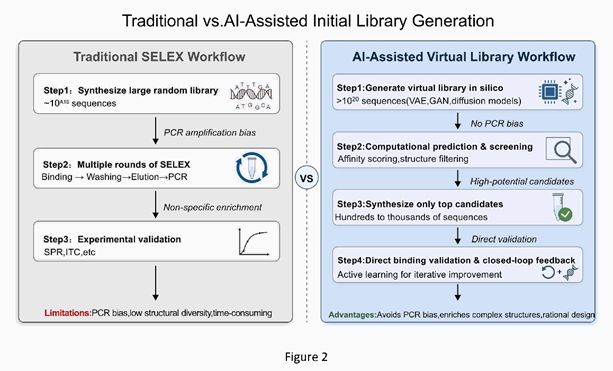
Figure 2. Conventional vs. AI-assisted library generation.
Figure 2 provides a side-by-side comparison of the conventional SELEX workflow and the AI-assisted virtual library workflow. Traditional SELEX requires the synthesis of massive random oligonucleotide libraries and repeated cycles of binding, washing, and amplification, a process highly susceptible to PCR bias. In contrast, AI-assisted workflows use deep generative models such as variational autoencoders (VAEs), generative adversarial networks (GANs), and diffusion models to construct virtual sequence libraries whose scale far exceeds that achievable through physical synthesis. These virtual libraries are then filtered through computational prediction and selection, so that only hundreds of high-confidence candidate sequences need to be synthesized for direct experimental validation. This transition not only avoids PCR bias but also enables efficient sampling of structurally complex sequences, dramatically improving the speed and efficiency of aptamer development.
Building on this foundation, the review systematically outlines the complete AI-driven aptamer development workflow, including the construction of bioinformatics databases, analysis of high-throughput SELEX data, prediction of secondary and tertiary aptamer structures, molecular docking calculations, molecular dynamics simulations, and free-energy estimation. It also highlights recent breakthroughs achieved by deep-learning models such as AlphaFold 3 and RoseTTAFoldNA in nucleic-acid structure prediction. Unlike reviews that focus narrowly on individual computational tools or on optimization of conventional SELEX methods, this work presents AI as a "new engine" driving aptamer design. In particular, it emphasizes the disruptive potential of recent advances in generative AI for de novo aptamer design, including AptaDiff, which is based on diffusion models; InstructNA and GRAPE-LM, both built on large language models, which employs deep reinforcement learning (Figure 3).
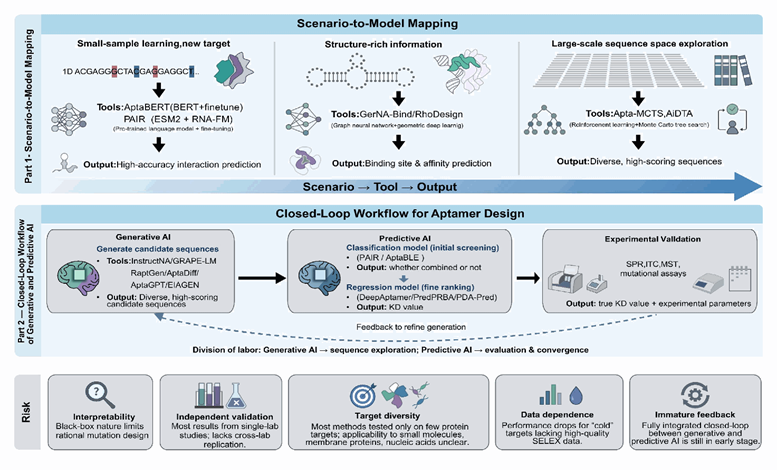
Figure 3. AI-driven aptamer design workflow and tool selection.
The review concludes that, although AI has substantially accelerated the virtual prescreening of candidate sequences, several challenges remain. These include the lack of standardized datasets, limited model interpretability, insufficient capacity to encode chemically modified nucleotides, and a disconnect between computational models and complex physiological environments. Future efforts should therefore integrate active learning, multimodal data fusion, and prospective experimental validation to establish closed-loop, interpretable AI frameworks that better align computational predictions with experimental outcomes, ultimately improving both the success rate of aptamer design and the efficiency of its clinical translation.
The study, entitled “Beyond SELEX: AI-Driven Aptamers from Sequence to Structure to Function,” was published online in Biotechnology Advances. Dr. Boming Cui from the Department of Pharmacy at Beijing Tsinghua Changgung Hospital is the first author. Lan Wang, Associate Chief Pharmacist at the Department of Pharmacy, Beijing Tsinghua Changgung Hospital, and Ge Yang, Associate Research Professor at the Institute of Medicinal Biotechnology, Chinese Academy of Medical Sciences, are the co-corresponding authors. This work was supported by the Chinese Academy of Medical Sciences Innovation Program for Medical and Health Sciences (CIFMS) and the Beijing Excellence Program for Research-Oriented Clinical Wards (BRWEP).
Paper link: https://doi.org/10.1016/j.biotechadv.2026.109075




 Research Updates
