On September 10, a multidisciplinary team from Tsinghua University published an article titled "Initial lessons from real-world implementation of an AI-agent eye clinic in China" in the international medical journal Nature Medicine. Based on the construction and real-world implementation experience of the AI-Agent Augmented Tsinghua Eye Clinic (AI-TEC), the article explores how medical artificial intelligence can transition from an "AI-assisted" model for single tasks to an "AI-native" health system that deeply improves clinical workflows, and summarizes the key challenges and early lessons faced when AI truly enters clinical practice.
With the rapid development of foundation models and generative AI, medical AI has made significant progress in tasks such as disease diagnosis, risk prediction, and medical image analysis. However, high-performance algorithms do not necessarily translate into more efficient healthcare services. Real-world clinical care is not a simple collection of isolated tasks, but a complex system composed of patients, clinicians, examination devices, clinical data, and care workflows. The core challenge for medical AI is shifting from "whether AI can perform a specific clinical task accurately" to "whether AI can truly integrate into clinical workflows and create measurable clinical value".
From "AI-Assisted" to "AI-Native"
Traditional medical AI is mostly embedded into existing clinical workflows as stand-alone tools, with different models undertaking individual tasks like image analysis, disease identification, or risk prediction. Ultimately, clinicians still need to manually review and integrate multiple AI outputs. This AI-assisted model fails to address systemic issues such as fragmented clinical information, workflow coordination, and medical resource allocation, and may even create an additional information-processing burden for clinicians.
Based on this, the team proposed the concept of an "AI-native health system": AI is no longer added as an external tool to existing workflows, but is embedded throughout the clinical workflow, continuously organizing information, supporting decisions, and coordinating the care process. The core of this concept is not simply deploying more AI models, but rethinking the role of AI within the healthcare system, shifting from optimizing single tasks to optimizing the entire care process.
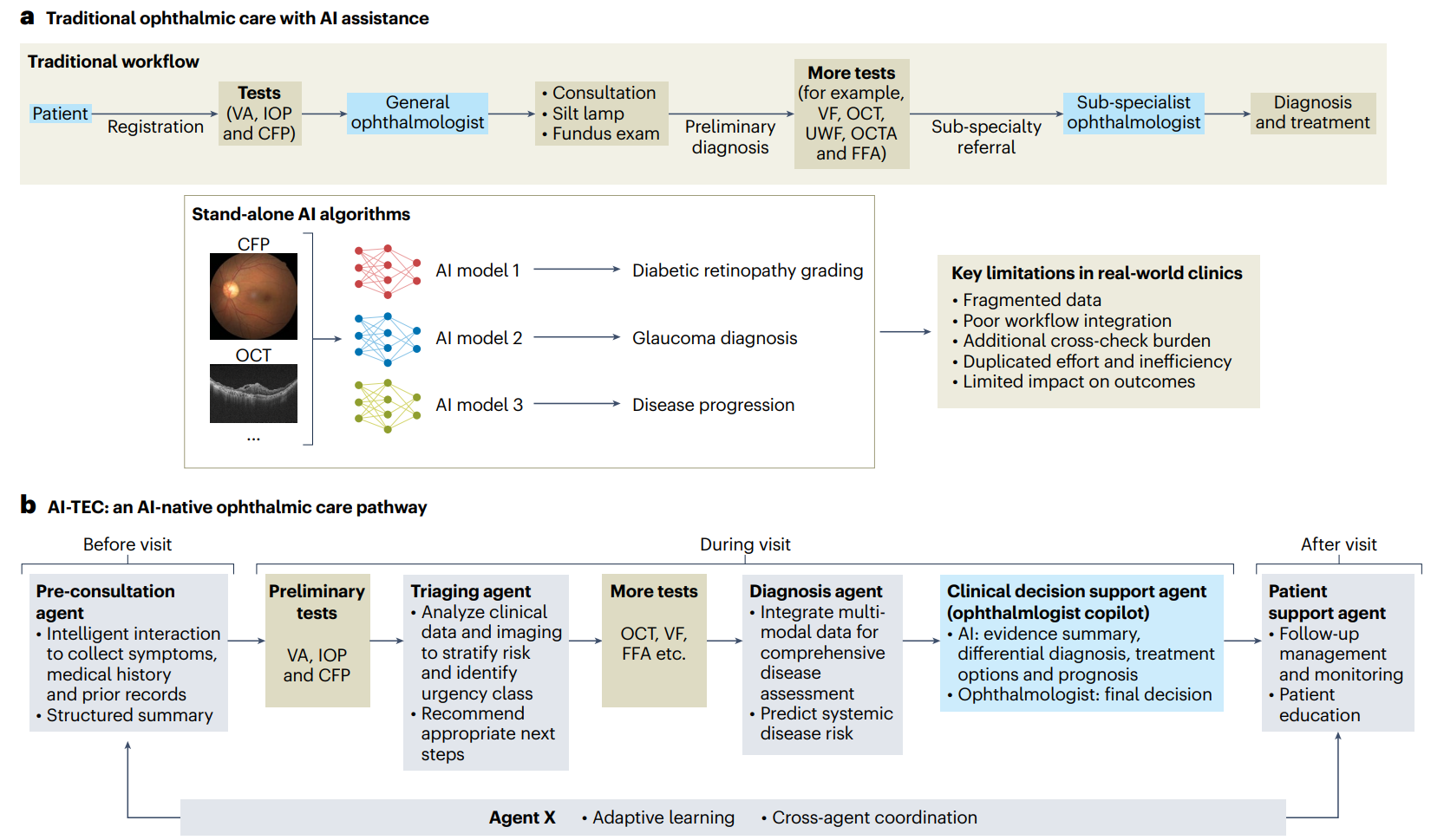
Figure : Overall design of AI-TEC
AI-TEC: Reconstructing Ophthalmic Care Workflows with a Multi-Agent System
Centered on this concept, the team developed the AI-Agent Augmented Tsinghua Eye Clinic (AI-TEC), a coordinated multi-agent clinical framework, deploying AI agents with different functions across the before, during, and after stages of clinical encounters, including pre-consultation, triaging, diagnosis, clinician decision support, and patient management. Unlike a simple combination of multiple stand-alone AI tools, AI-TEC emphasizes information flow and coordination among agents: the pre-consultation agent organizes patient-reported symptoms and medical history; the triaging agent supports risk stratification and test allocation; the diagnosis agent integrates multimodal ophthalmic data; the clinician decision support agent provides evidence-informed information; and the patient support agent extends healthcare services into education, follow-up, and long-term management. Clinical information generated at one stage can be continuously transferred to inform subsequent decisions, gradually transitioning AI from isolated tools into an intelligent connected layer across patients, clinicians, clinical data, and care workflows.
In November 2025, an early prototype of AI-TEC was integrated into the hospital information system of Beijing Tsinghua Changgung Hospital, embedding AI capabilities such as pre-consultation and fundus image analysis into routine clinical workflows. Real-world operation experience demonstrated that implementing AI in clinical settings is not merely an algorithmic issue, but an ecosystem challenge jointly determined by data quality, workflow integration, clinician engagement, and continuous iteration. For example, expert-reviewed high-quality data can substantially enhance AI performance; optimizing system design and operational workflows can significantly improve clinicians' willingness to use the system; and continuous clinician feedback can support the continuous evolution of the agents.
From Algorithmic Performance to Real-World Clinical Value
The article points out that once AI enters a real-world clinical environment, relying solely on traditional algorithmic metrics such as accuracy, sensitivity, or specificity is no longer sufficient to comprehensively evaluate its value. Even if a model demonstrates good technical performance, it may fail to yield real clinical benefit due to workflow mismatches, suboptimal information display, unclear responsibility boundaries, or insufficient coordination in referral and treatment pathways.
The early implementation of AI-TEC also revealed a series of issues worthy of attention. For instance, while silent trials can evaluate the system's real-world operation without directly influencing clinical decisions, they are limited in directly measuring the actual impact of AI on clinician decisions, healthcare efficiency, and patient outcomes. Furthermore, real-world reference standards (ground truth) may inherently possess uncertainty; and disease-centric algorithmic tasks may not fully align with patients' symptoms and care-seeking needs. At the same time, whether an effective closed loop of referral, definitive diagnosis, treatment, and follow-up can be formed after screening also determines whether AI can ultimately be translated into clinical value.
Therefore, the evaluation of medical AI needs to further shift from "model accuracy" to "whether AI truly improves healthcare"—whether it can improve healthcare efficiency and accessibility, optimize clinical decisions and resource allocation, reduce clinician burden, and ultimately improve patient management and health outcomes.
Integrating Medical AI into Clinical Practice Is a Systems Engineering Challenge
The explorations of AI-TEC indicate that for medical AI to truly enter clinical practice, it requires more than just deploying more advanced models into hospitals. It requires synchronously driving clinical workflow transformation, an evaluation paradigm shift, and governance mechanism development. Its ultimate value depends not on how many models are deployed, but on whether it establishes safer, more efficient, more accessible, and patient-centered healthcare delivery.
Professors Jiamin Wu, Ya Xing Wang, Qionghai Dai, and Tien Yin Wong from Tsinghua University are the co-corresponding authors, and postdoctoral fellows Tao Yan and Di Zhang are the co-first authors. The research was collaboratively completed by teams from the Department of Automation at Tsinghua University, the Beijing Visual Science and Translational Eye Research Institute (BERI), Tsinghua Medicine, and Beijing Tsinghua Changgung Hospital.




 Research Updates