New Research
Tendinopathy is a common musculoskeletal disorder that can cause persistent pain, impaired mobility and athletic performance, and an increased risk of spontaneous tendon rupture. Transforming growth factor-β1 (TGF-β1) is a key driver of tendon fibrosis and collagen matrix disorganization. However, selectively controlling excessive TGF-β1 within diseased tendons while minimizing interference with its physiological functions remains a major challenge in the treatment of tendinopathy.
A research team led by Professor Jia-Kuo Yu at the Orthopedic and Sports Medicine Center of Beijing Tsinghua Changgung Hospital, Tsinghua University, has developed a new strategy to remodel the pathological tendon microenvironment by capturing excess TGF-β1 directly at the site of injury using a fully natural, self-assembling peptide (Fig. 1).
The team designed a modular self-assembling peptide, termed “AsPep-FTSQ”, composed entirely of natural amino acids. Following local injection into diseased tendon tissue, AsPep-FTSQ spontaneously assembles into an interconnected nanofibrous network in situ. This network continuously sequesters excess free TGF-β1 within the local microenvironment, thereby suppressing aberrant pro-fibrotic signaling, limiting pathological tendon cell state transitions, and promoting the realignment of collagen fibers along the principal load-bearing axis of the tendon. The regenerative effects of this strategy were demonstrated in both rat and beagle models of tendinopathy, in which AsPep-FTSQ improved tendon structural organization and functional repair.
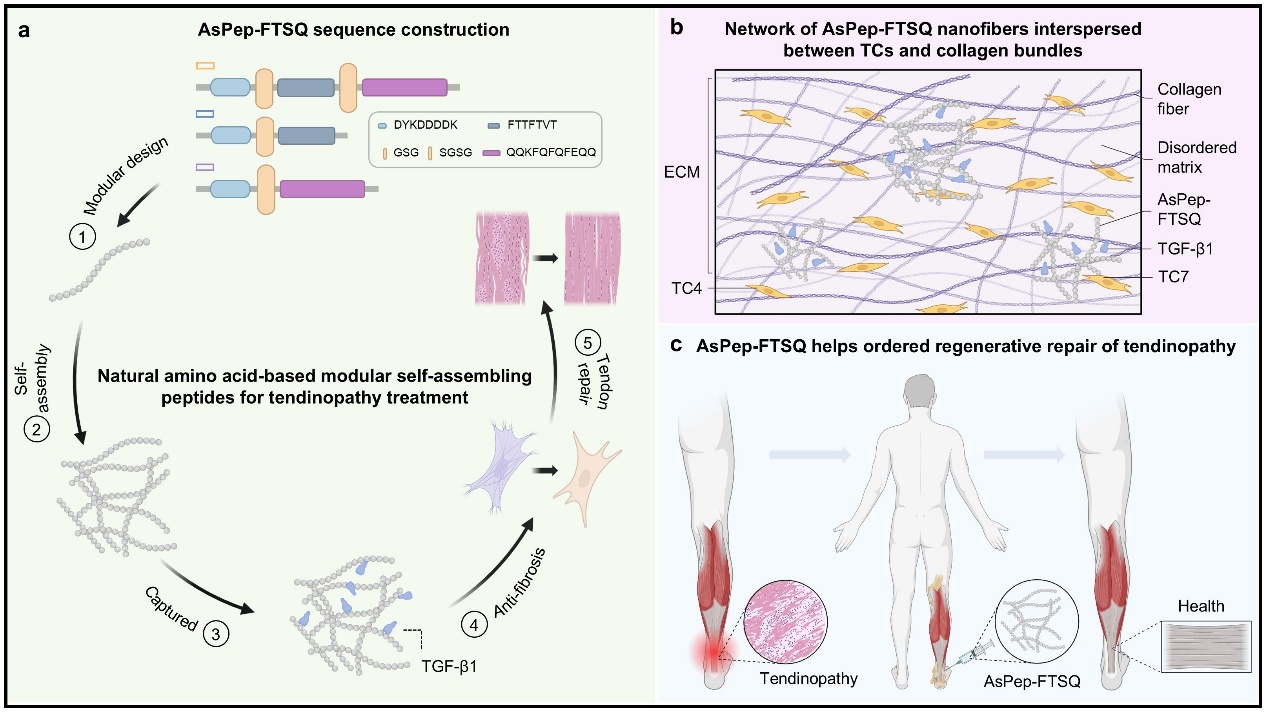
Fig. 1 | AsPep-FTSQ self-assembles into a nanofibrous network in diseased tendon tissue, sequestering excess TGF-β1 and promoting organized tendon regeneration.
The study established an integrated research framework spanning “single-cell mechanistic analysis, modular molecular design, molecular binding validation, functional evaluation in small-animal models, and translational validation in a large-animal model” (Fig. 2). Unlike conventional systemic approaches that broadly inhibit TGF-β1 signaling, AsPep-FTSQ forms a high-density nanofibrous network specifically within the pathological site, enabling sustained local sequestration of excess free TGF-β1. This localized approach is designed to suppress chronic and aberrant pro-fibrotic signaling while minimizing disruption of the physiological functions of TGF-β1 elsewhere in the body.
Importantly, the platform is highly modular and programmable. By replacing its target-recognition sequence, the same molecular architecture could potentially be adapted to capture other disease-associated cytokines. This design concept may therefore have applications beyond tendinopathy, including fibrotic disorders affecting other soft tissues such as the heart, lung, and liver.
By integrating mechanistic investigation of sports-related tendon injury with biomaterial engineering, molecular self-assembly, and cross-species preclinical evaluation, the study provides a new conceptual framework for treating tendinopathy. Rather than focusing primarily on symptom relief, the approach seeks to “precisely remodel the pathological tissue microenvironment”, offering both a mechanistic basis and a potentially versatile material platform for regenerative therapy.
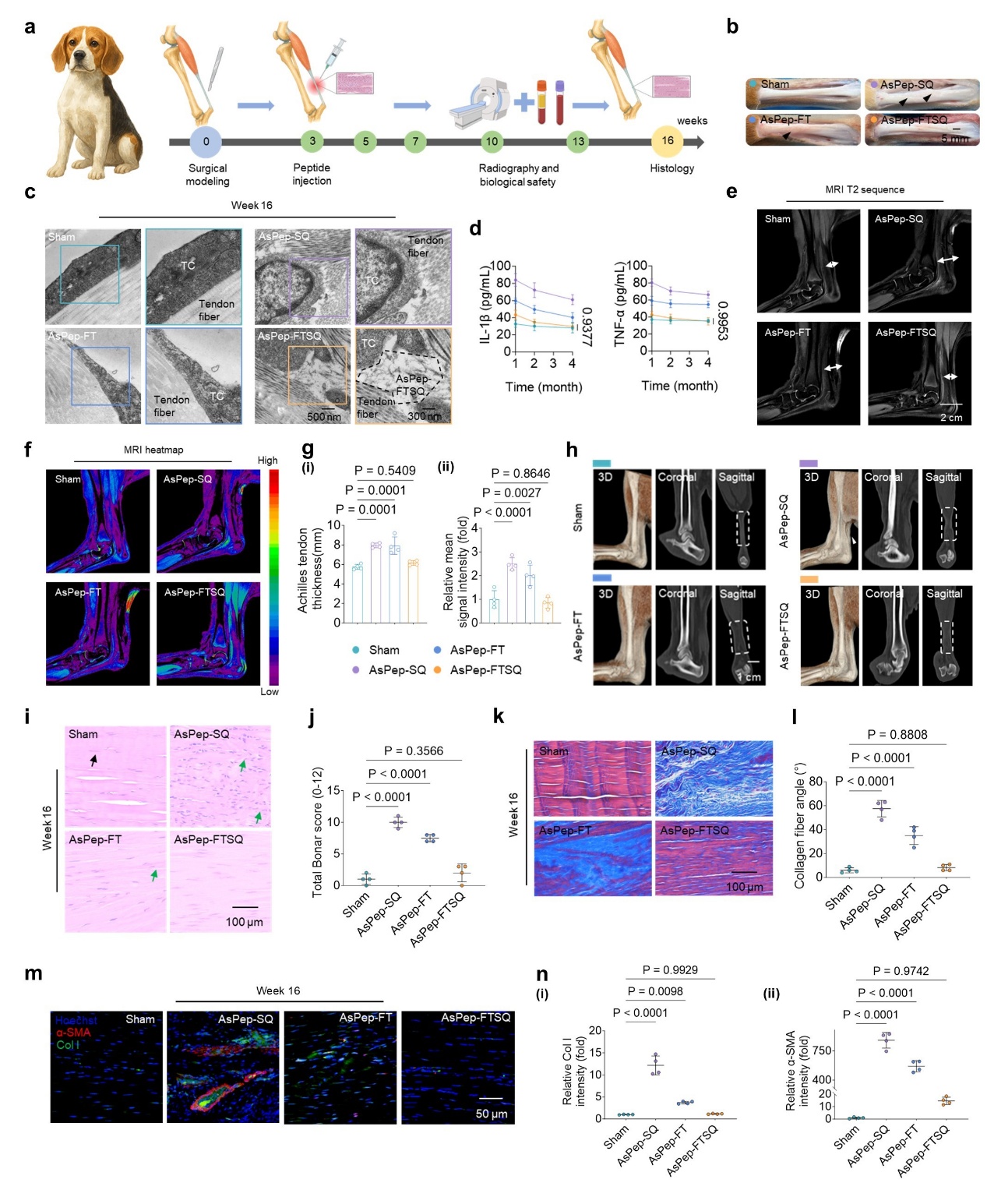
Fig. 2 | AsPep-FTSQ forms an in situ nanofibrous network within beagle tendon tissue, demonstrating cross-species tendon repair and translational potential.
The study, entitled “A modular self-assembling peptide platform targeting TGF-β1 for tendon regeneration,” was published in Nature Communications. Chao Li from the Department of Medicine at Peking University and Zehao Chen of Tongren Hospital Affiliated to Shanghai Jiao Tong University School of Medicine are the co-first authors of this study. Jiakuo Yu and Huawei Liu, Deputy Chief Physician at Beijing Tsinghua Changgung Hospital, as well as Guoqing Cui, a doctoral supervisor at the Peking University Department of Medicine, are the co-corresponding authors.
The research was supported by the National Natural Science Foundation of China, the National Key Research and Development Program of China, the Beijing Municipal Natural Science Foundation, the Capital Clinical Characteristic Diagnosis and Treatment Technology Research and Translational Application Project, and other research programs.
Article link:
https://www.nature.com/articles/s41467-026-76487-3




 Research Updates