On October 22, Professor Tan Chorh Chuan, Chairman of the Agency for Science, Technology and Research (A*STAR), Chairman of the Singapore Ministry of Health Office for Healthcare Transformation, former President of the National University of Singapore, Member (International) of the US National Academy of Medicine and Fellow of the Singapore National Academy of Science, delivered the 276th lecture of the Tsinghua Global Vision Lecture Series. His presentation was titled “Healthcare Transformation and the Role of AI”. Professor Wong Tien Yin, Vice Provost of Tsinghua University and Senior Vice-Chancellor of Tsinghua Medicine, hosted the event and presented a commemorative plaque to Professor Tan Chorh Chuan.
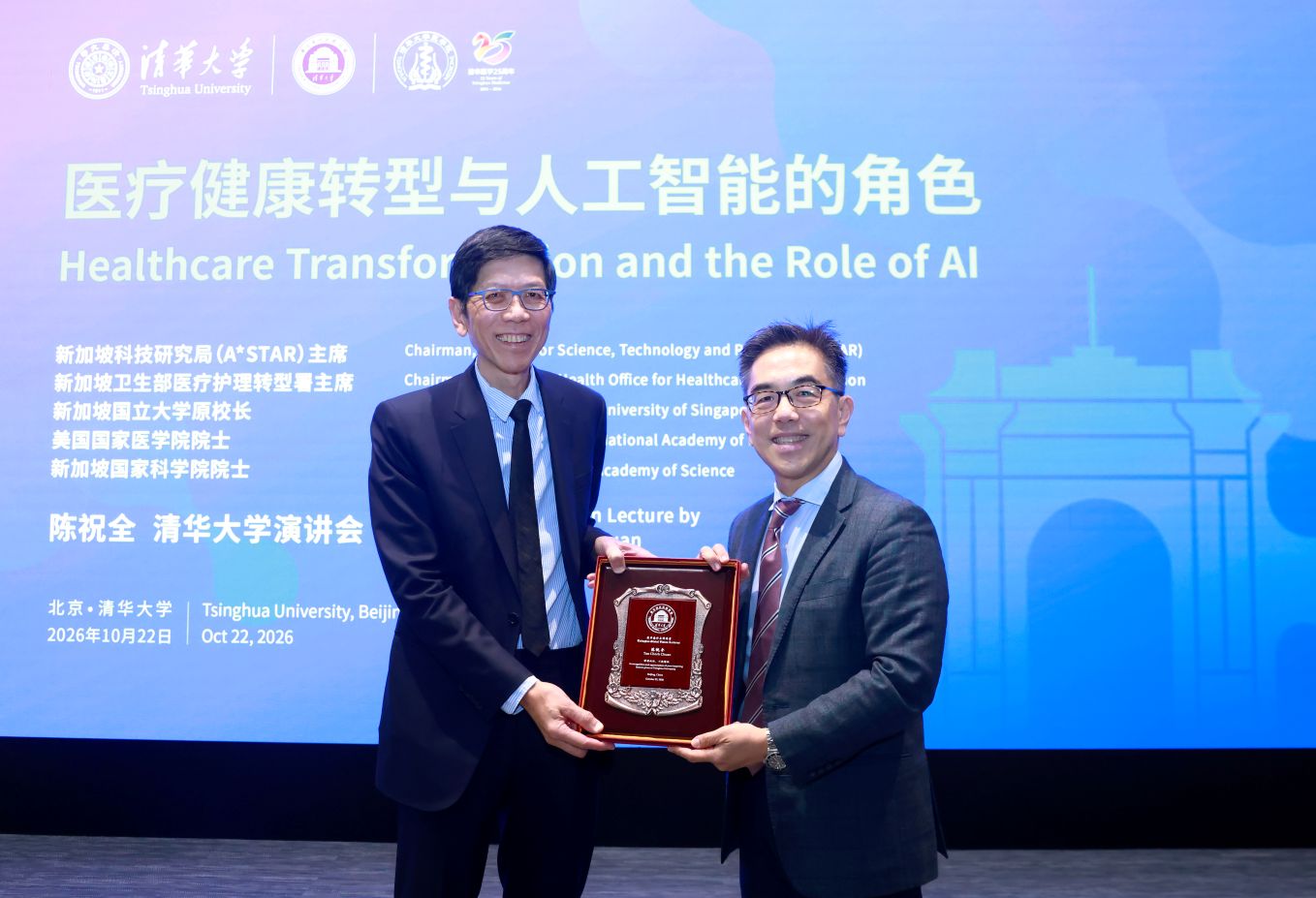
Wong Tien Yin presents the commemorative plaque to Tan Chorh Chuan.
In his opening remarks, Wong Tien Yin noted that global healthcare systems are under growing strain amid accelerating population ageing and a rising burden of chronic diseases, while artificial intelligence is opening up new opportunities for transformation in healthcare. With extensive experience in public health governance and healthcare reform, Professor Tan’s insights would offer valuable references for exploring healthcare transition in the digital age.
Lecture Scene
During the lecture, Professor Tan illustrated the context and direction of healthcare system transformation with Singapore’s practical cases. He explained that Singapore has achieved favorable population health outcomes with a relatively low share of healthcare spending in GDP. Nevertheless, rapid ageing and the growing prevalence of chronic diseases keep putting pressure on its health system. To address these challenges, Singapore has carried out transformation of the health system, focusing on disease prevention, seamless and coordinated care delivery, and balancing clinical outcomes and costs. The country adopts a whole-of-society, integrated life course approach, builds integrated healthcare clusters and strengthens primary care foundations.
Professor Tan elaborated on the vital role of AI in healthcare transformation. Citing Singapore’s clinical applications including AI-assisted spinal surgery and intelligent screening on lung CT scans, he demonstrated that AI can boost the efficiency and accuracy of diagnosis and treatment. Data and AI empower conventional population health management and underpin predictive, preventive and precision health models. Singapore has rolled out relevant initiatives such as diabetes risk prediction, genetic disorder screening and digital phenotyping for mental health management.
He also pointed out practical barriers to the deployment of medical AI, including data availability, translation of research outcomes, public trust, ethics and safety. Surveys has shown that the public hold both expectations and concerns over medical AI. Accordingly, the adoption of such technologies must uphold fundamental principles covering data privacy, human oversight and algorithmic explainability. Singapore is advancing the translation and deployment of medical AI in a prudent manner through secure data platforms and targeted research programmes.
In the Q&A session, faculty and students raised questions on topics including healthcare reform for ageing populations, ethical governance of medical AI, and the use of real-world data. Professor Tan encouraged young researchers to ground their work in real health needs, balance technological innovation with ethical standards, and pursue application-oriented interdisciplinary research.
The event was co organized by the Office of International Affairs and Tsinghua Medicine at Tsinghua University.
Since its launch in 2007, the Tsinghua Global Vision Lecture Series has continued to bring together world‑renowned scholars, political figures, and industry leaders, serving as an important platform for broadening the international perspectives of faculty and students and deepening global academic cooperation and cultural exchange.



 News
